The Failure Gap
+ Justin Rose, Daniel Coyle & Courageous CEOs


“The secret of happiness is to admire without desiring.” — Carl Sandburg
Hey Coaches,
Here you go!
✍️ Articles
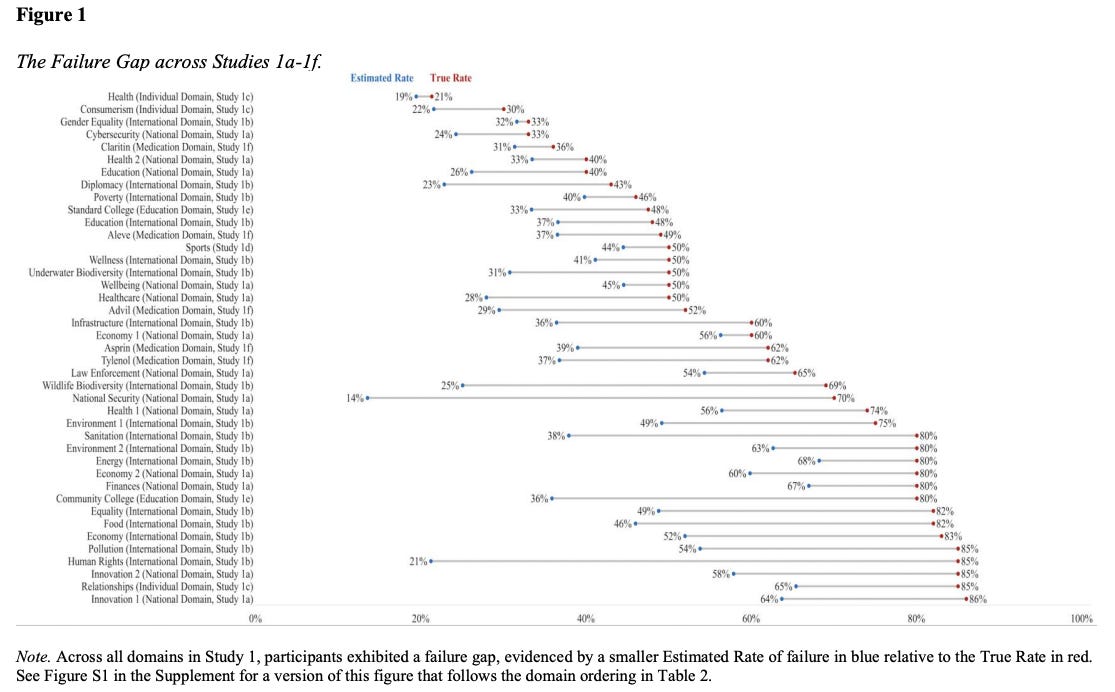
The Failure Gap: This academic study is phenomenal and pulls on past research by Kahneman & Tversky, James Surowiecki, Carol Dweck, etc. It’s 55 pages before endnotes, I would read the following pages: 2-14, 24-25, Discussion sections on pages 30, 35, 38, 42-43, 47, and finally pages 50-57 (27 pages total, not bad). If that’s too long, read this article that’s by the same authors and mostly a summary of the topic (not as good though!).
Abstract: People are systematically unaware of the mishaps, problems, and failures around them, a phenomenon we dub the failure gap. People underestimate tens of thousands, and in some cases, millions of failures at the individual, national, and international level across 30+ life domains (Study 1). For every three species that go extinct, the public knows of one; for every five weapons undetected by airport security, people think one sneaks by. Why are people unaware of the problems around them? Failure is under-reported relative to success (Studies 2-5). The failure gap had policy implications for key decision makers. Closing the failure gap reduced support for harsh punishment (e.g., school suspensions) among educators, lowered support for mass incarceration among voters, led managers to extend paid parental leave to new mothers, and shrank social stigma in the workplace (Studies 6 and 7). Taken together, the failure gap is common, crippling, and encouragingly, correctable.
Across 30+ domains, failure occurred an average of 61% of the time; yet people believed the failure rate was around 41%….People believed teams in the National Hockey League collectively lose fewer than 50% of their games—a logical impossibility in a sport where each time one team loses, another wins.
when a failure occurs, it is psychologically costly for someone close to the failure to share it. Negative information about the self—especially failure—is ego-threatening. Contemplating it, let alone sharing it, runs counter to two of the most foundational human motives: the desire to feel competent.
People closest to a failure—those with the clearest access to information about a failure that occurred—will tend to be those with the strongest motive not to share it. This could seriously impede the accessibility of information.
Courageous conversations: How to lead with heart: For CEOs, courageous conversations are not side work; they are the work. When leaders surface truths and teach what matters through their words and actions, they teach the organization how to think, decide, and grow.
In sport, a Premier League manager told us his most important conversations were not with star players but with assistant coaches willing to challenge his tactics midseason. “That saved our campaign,” he said. The CEO of a global manufacturing firm begins each executive meeting with the question: “What are we not seeing? What are we not saying?” Over time, this shifted the culture from guarded compliance to open contribution.
🎙️ Podcast
The Daily Stoic: The Stoic Secrets Great Leaders Use | Daniel Coyle: Coyle talks about why the best teams aren’t run like machines, why connection matters more than control, and what Marcus Aurelius can teach us about leadership that endures. There are a lot of ads - liberally fast forward as they come on. [3/21/26 — 35 minutes] Apple | Spotify
💭 Miscellaneous
Dr. Gio Valiante is performance coach to golfers and top investors (formerly Steve Cohen’s coach). Check out this clip he shared below:

Rory McIlroy on Happiness and Success

